Precision OEM/ODM Hardware Solutions
Macro Dynamics & Global Demand for Precision OEM Metal Clips
Analyzing the structural shifts in electromechanical fastening, automated assembly efficiency, and high-performance spring alloy fabrication across critical industrial sectors.
Automotive Electrification
Modern Electric Vehicles (EVs) require lightweight, vibration-resistant battery retention clips, busbar grounding clamps, and high-voltage cable clips capable of sustaining severe structural stress and elevated thermal cycles without mechanical fatigue.
Hyperscale AI Infrastructure
High-density GPU racks and server architectures demand custom beryllium copper and stainless steel EMI shielding clips, optical module retaining springs, and quick-release latching clips engineered for rapid maintenance and zero insertion-loss grounding.
Aerospace & Defense Reliability
In high-altitude, extreme-vibration environments, precision wire clips, retaining rings, and panel fasteners manufactured from Inconel and titanium alloys ensure structural cohesion and fail-safe power distribution across critical avionic sub-assemblies.
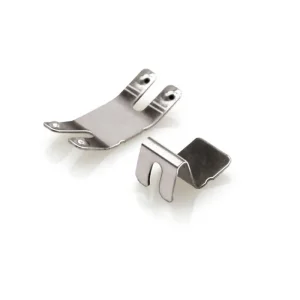
The global industrial hardware ecosystem is undergoing a fundamental transformation driven by miniaturization, automated robotic assembly, and stringent environmental durability standards. OEM metal clips—ranging from simple R-shaped spring pins to intricate multi-stage progressive stamped contact clips—represent the silent baseline of structural integrity in modern manufacturing. As tier-1 OEMs transition toward zero-defect supply chains, contract manufacturing factories must possess advanced metallurgical knowledge, finite element analysis (FEA) capabilities, and high-speed progressive die tooling expertise to meet evolving technical criteria.
High-Performance Alloy Selection & Surface Metallurgy
Selecting the optimal substrate material, temper condition, and electroplating regime to achieve exact spring force, yield strength, and anti-corrosion benchmarks.
| Alloy Grade | Tensile Strength (MPa) | Electrical Conductivity (% IACS) | Corrosion Resistance | Primary Industrial Application |
|---|---|---|---|---|
| Stainless Steel 301 (Full Hard) | 1300 – 1550 | ~2.5% | High (Atmospheric/Chemical) | High-yield spring clips, panel fasteners, structural retainers |
| Beryllium Copper C17200 (TH04) | 1100 – 1350 | 22% – 28% | Excellent | EMI shielding fingers, battery contact clips, RF connectors |
| Phosphor Bronze C5191 / C5210 | 600 – 800 | 13% – 15% | High (Marine/Moisture) | PCB grounding clips, electrical switch contacts, micro-switches |
| High Carbon Spring Steel (SK5 / 65Mn) | 1200 – 1700 (Post-QT) | ~8% | Moderate (Requires Plating) | Heavy-duty hose clamps, automotive retaining rings, tool clips |
| Titanium Grade 5 (Ti-6Al-4V) | 900 – 1100 | ~1% | Exceptional (Extreme/Salt) | Aerospace structural clips, medical implantable hardware |
Heat Treatment & Stress Relieving Protocols
To prevent hydrogen embrittlement and elastic relaxation under continuous load, our OEM metal clip factory utilizes specialized atmosphere-controlled heat treatment furnaces. For spring steels, quenching and tempering (Q&T) at controlled heating rates locks in martensitic grain structures. Copper-based alloys such as Beryllium Copper undergo precipitation age-hardening at 315°C for 2 to 3 hours, maxing out tensile yield strength while stabilizing mechanical springback parameters.
Advanced Surface Plating & Finishing Options
Surface engineering protects clips against galvanic corrosion and ensures smooth mating forces. Options include reel-to-reel selective gold plating for ultra-low contact resistance, electro-galvanized zinc with trivalent chromium passivation (Cr6-free), electro-less nickel plating for uniform thickness inside complex bends, and protective fluoropolymer/DACROMET coatings for 1,000+ hour salt-spray endurance in harsh automotive undersides.
High-Speed Stamping, Wire Forming & Tooling Mechanics
From CAD simulation and FEA stress modeling to progressive die stamping and automated multi-slide wire bending, explore how precision clips are manufactured at scale.
Progressive Die Stamping
Multi-station carbide progressive tooling capable of speeds up to 1,200 strokes per minute. Integrates piercing, lancing, forming, and coining in a single continuous automated reel-to-reel layout.
CNC Multi-Slide Forming
Cam-less 3D multi-slide wire and strip forming technology. Ideal for complex 3D bend geometries, reducing tooling development costs by 40% compared to traditional stamping dies.
FEA Springback Modeling
Advanced non-linear Finite Element Analysis simulates material springback and plastic deformation during die design, ensuring first-article dimensional accuracy without expensive trial-and-error re-tooling.
In-Line Vision Inspection
High-resolution optical sensors integrated directly inside the press tooling detect sub-micron burrs, missing pierces, and pitch variations, instantly ejecting defective parts before reel collection.
Engineering Formula Focus: Cantilever Beam Clip Force Calculation
Designing high-reliability metal clips requires accurate mathematical forecasting of deflection ($P$) vs. normal clamping force ($F$). For a standard flat strip cantilever spring clip under elastic deflection, the normal force is governed by the classic Timoshenko beam formula:
Note that thickness ($t$) is cubed—meaning a 10% increase in raw material strip gauge results in a 33% increase in retention force. Our engineering DFM team performs rigorous tolerance stack-up modeling to ensure clip engagement forces stay strictly within specified Ergonomic Insertion Limits (EIL) and Minimum Retention Thresholds (MRT).
End-to-End Application Engineering & Industrial Solutions
Custom metal clip configurations optimized for demanding mechanical, electrical, and environmental performance vectors worldwide.
Automotive Body & Trim Clips
Including U-nuts, chimney nuts, trim panel spring clips, and wiring harness retention clamps. Engineered with anti-rattle geometry and self-retaining barb structures to streamline rapid assembly along automotive assembly lines.
Telecom & RF Shielding Clips
Micro-stamped PCB grounding clips, board-to-board contact fingers, and optical transceiver latches. Plated in high-purity gold or matte tin to guarantee low contact resistance and high insertion lifecycle endurance (>10,000 mating cycles).
Medical Device Retainers
Miniature biocompatible stainless steel 316L and Grade 5 titanium wire clips used in diagnostic equipment, surgical tool ratchets, and implantable sensor housings. Manufactured inside ISO Class 7 cleanroom environments.
Renewable Energy Busbar Clips
Heavy-gauge copper and stainless steel spring clamps designed for solar inverter power modules and wind turbine converter cabinets. Built to maintain continuous clamping pressure under severe thermal expansion/contraction cycles.
Architectural & Solar Panel Clips
Stainless steel 304/316 solar panel grounding clips and standing seam roof mounting clamps. Features aggressive grounding teeth that penetrate anodized aluminum frame coatings for instant electrical bonding.
Heavy Machinery Hose & Cable Clamps
High-carbon spring steel clips engineered with double-bead structures for uniform radial clamping pressure on hydraulic lines, preventing fluid leakage under intense pulsation and extreme ambient pressure changes.
Stringent Quality Systems & Global Supply Chain Resilience
Combining complete material traceability, PPAP Level 3 documentation, and localized VMI warehousing hubs for smooth international procurement.
Rigorous 6-Stage Quality Control Protocol
Our factory strictly enforces IATF 16949 and ISO 9001 quality management systems across every production batch. From raw coil incoming inspection to automated optical sorting, zero-defect quality is embedded into our operational culture.
Incoming Material Spectrometry Verification
XRF alloy analyzer scans verify chemical composition and mill certificates before coil slitting.
First Article Inspection (FAI) & CMM Audit
Full 3D coordinate measurement machine (CMM) and optical comparator validation against CAD models.
Continuous SPC Charting & Force Testing
Automated load-deflection curve testing monitors spring rate consistency throughout press runs.
Global Localization & VMI Support
To protect international client supply chains against ocean freight volatility and tariff shifts, we offer Vendor Managed Inventory (VMI) services, safety stock buffering, and localized distribution hubs in North America and Europe.
- Full Compliance: RoHS, REACH, Conflict Minerals (3TG) documentation.
- PPAP Submissions: Level 1 through Level 5 submission packages tailored to OEM specs.
- Flexible Logistics: DDP, FOB, CIF, and Kan-Ban consignment inventory arrangements.
Next-Generation Metal Clip Innovation (2025–2035)
Exploring smart micro-sensor integration, eco-friendly plating chemistry, and ultra-high-strength micro-stamping frontiers.
Smart Sensing Clips
Integration of micro-thin piezoelectric strain sensors onto critical aerospace retention clips to enable real-time structural health monitoring (SHM) and predictive failure alerts under dynamic loads.
Zero-Carbon Finishing
Transitioning toward closed-loop water recycling and zero-VOC organic coating lines, assisting tier-1 global partners in reducing Scope 3 upstream carbon footprints across high-volume metal component sourcing.
Nanocrystalline Alloys
Development of ultra-fine grain nanocrystalline stainless steel strips providing up to 25% higher fatigue endurance limits, allowing thinner gauge designs that reduce component mass without forfeiting force.
Frequently Asked Questions on OEM Metal Clip Manufacturing
In-depth technical answers regarding tooling timelines, material choices, prototype-to-production scaling, and mechanical testing.
What is the typical lead time for custom stamping tooling vs. rapid prototypes?
For initial functional prototypes, we utilize Wire EDM (Electrical Discharge Machining), CNC laser cutting, and soft-tool wire forming to supply fully functional samples within 3 to 7 working days. For high-volume production, full hard carbide progressive stamping dies typically require 3 to 5 weeks for complete design, T1 sample trials, and CMM dimension validation.
How do you guarantee force consistency across millions of stamped clips?
Force consistency depends on raw coil material thickness tolerance and precise heat treatment control. We order raw strip coils with restricted thickness tolerances (down to ±0.005mm instead of standard ASTM ±0.015mm). Furthermore, our automated presses incorporate continuous sensor monitoring that tracks force displacement during coining/bending, automatically flagging any deviation in material springback.
Which alloy is best suited for high-temperature electrical grounding clips?
For operating environments exceeding 150°C (such as automotive engine bays or high-power server PSU modules), standard phosphor bronze experiences stress relaxation over time. We recommend Stainless Steel 301/304 or Beryllium Copper C17200 with heat treatment, as these alloys retain over 90% of their initial spring retention force under continuous thermal exposure up to 250°C.
How is hydrogen embrittlement prevented in high-carbon steel spring clips?
High-carbon steels (such as SK5, 65Mn, or 1075) subjected to acid pickling or electroplating can absorb atomic hydrogen, causing sudden brittle failure under load. Our factory enforces a mandatory post-plating baking bake-out process (De-hydrogenation) at 190°C to 210°C for 4 to 8 hours within 4 hours after electroplating to completely eliminate trapped hydrogen molecules.
Can you provide custom reel-to-reel packaging for automated pick-and-place placement?
Yes. We design custom carrier tape and reel packaging adhering to EIA-481 standards, allowing micro-clips and EMI shielding fingers to be seamlessly fed directly into automated surface-mount (SMT) or high-speed robotic assembly equipment on your factory floor.
What quality reports accompany international OEM shipments?
Every production batch is shipped with a comprehensive quality dossier including Material Test Reports (MTR) with mill heat numbers, Plating Thickness Measurement (X-ray fluorescence) certificates, Dimensional Inspection Reports (CMM/Optical), Heat Treatment Hardness test logs, and Certificate of Compliance (RoHS/REACH). PPAP Level 3 documentation is available upon request.