China China Suppliers High-Performance Copper Heatsink Factory for Maximum Thermal Conductivity in High-Power Electronics Manufacturers, Product
Product Description
Product Overview
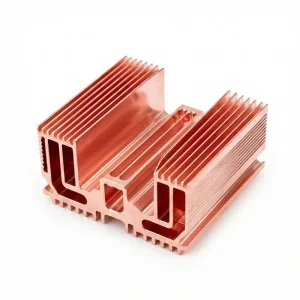
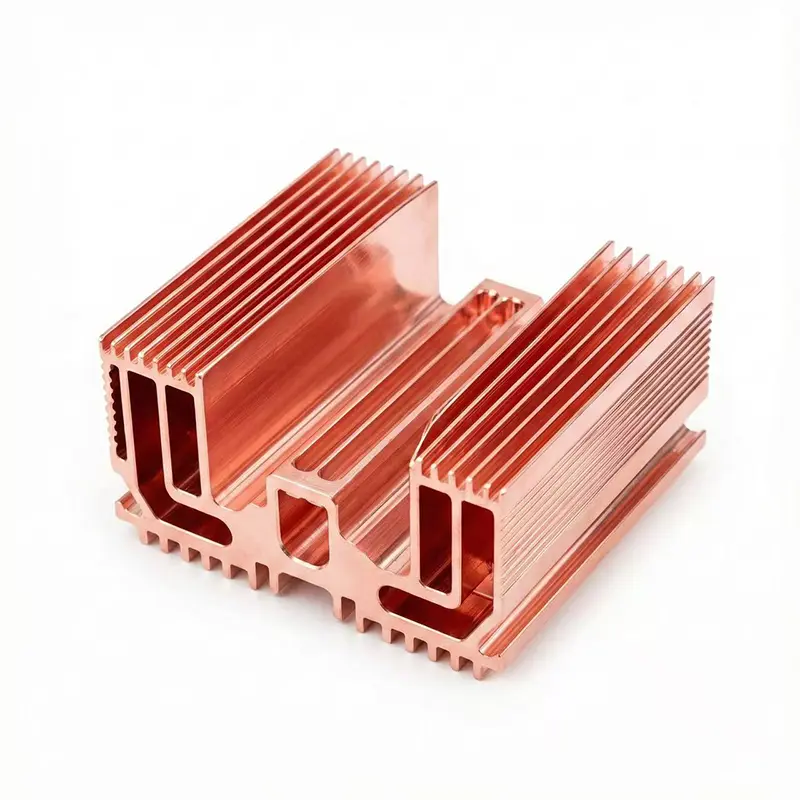
Designed for high-power electronic devices, this copper heatsink maximizes thermal conductivity. Copper is notoriously difficult to machine due to its ductility ("gumminess"), but it offers superior heat dissipation compared to aluminum. This product showcases our ability to handle challenging materials for functional applications.
Manufacturing Process Insight
CNC Milling
We use sharp, polished carbide tools and specific cutting strategies to prevent the soft copper from sticking to the cutter (built-up edge).
Fin Machining
The tall, thin cooling fins are machined with high aspect ratios. We carefully control feed rates to prevent the fins from bending during the cutting process.
Flatness Control
The base contact area is fly-cut to achieve extreme flatness and a mirror-like finish, ensuring maximum thermal transfer efficiency with the CPU or heat source.
Key Features & Benefits

Superior Thermal Conductivity
Copper (approx. 400 W/m·K) transfers heat almost twice as fast as Aluminum.

Complex Geometries
CNC machining allows for custom fin shapes and mounting holes that extrusion cannot achieve.

Surface Protection
Can be treated with anti-oxidation coating or nickel plating to prevent tarnishing over time.

Application
Ideal for lasers, 5G base stations, and high-performance computing (HPC) cooling.
Technical FAQ
Q Q1: Why choose CNC over extrusion for heatsinks?
A1: CNC allows for prototypes, low volumes, and complex 3D shapes (like pin fins) that extrusion cannot produce.
Q Q2: Copper is expensive. Can you help reduce costs?
A: We can suggest hybrid designs (Copper base + Aluminum fins) or optimize the design to reduce machining time.
Q Q3: How do you prevent copper from oxidizing?
A3: We vacuum pack parts immediately after cleaning and can apply clear passivation or plating.
Other Products
Get a Fast, Technical Quote & Free DFM Review
Don't let tolerance stack-up delay your product launch. Submit your project details, and our engineering team will evaluate your design for manufacturability before the first cut.
Frequently Asked Questions
1 What materials are best suited for CNC-machined heatsinks?
Copper and aluminum are the two most common materials. Copper offers approximately twice the thermal conductivity of aluminum (~400 W/m·K vs. ~200 W/m·K), making it ideal for high-power applications. Aluminum is lighter and more cost-effective for general-purpose cooling.
2 What is the minimum order quantity (MOQ) for custom CNC copper heatsinks?
We support prototype quantities starting from a single piece, all the way up to high-volume production runs. There is no strict MOQ — we tailor our production planning to your specific project requirements and budget.
3 What surface finishes are available for copper heatsinks?
We offer several surface treatment options including electroless nickel plating, clear passivation, tin plating, and polishing. These treatments protect against oxidation, improve solderability, and enhance the appearance of the finished part.
4 How flat can the base contact surface be machined?
Using fly-cutting techniques, we can achieve flatness tolerances within ±0.005 mm on the base contact surface. This mirror-like finish ensures maximum thermal contact and minimizes thermal interface resistance between the heatsink and the heat source.
5 Can you produce heatsinks with both copper base and aluminum fins?
Yes. Hybrid heatsink designs — combining a copper base for rapid heat absorption with aluminum fins for lightweight heat dissipation — are a cost-effective solution we commonly produce. This approach reduces material cost while maintaining excellent thermal performance.
6 What industries commonly use CNC-machined copper heatsinks?
CNC copper heatsinks are widely used in high-performance computing (HPC), 5G base station infrastructure, industrial laser systems, power electronics, RF amplifiers, and medical imaging equipment — any application where reliable thermal management under high heat loads is critical.